Should Be Asleep
I don't actually remember the first time I became aware of Should Be Asleep, but I can say with certainty that the YouTube algorithm brought me there. In general I don't care for algorithmic discovery: I prefer expert curation; I dislike the idea of Being Known by the machines; [insert other clichés here to your liking]. I would go so far as to say I've fashioned this very website as a remediation against our current computation-based recommendation ecosystem. But some things can't be helped, and the YouTube algorithm is better than most.
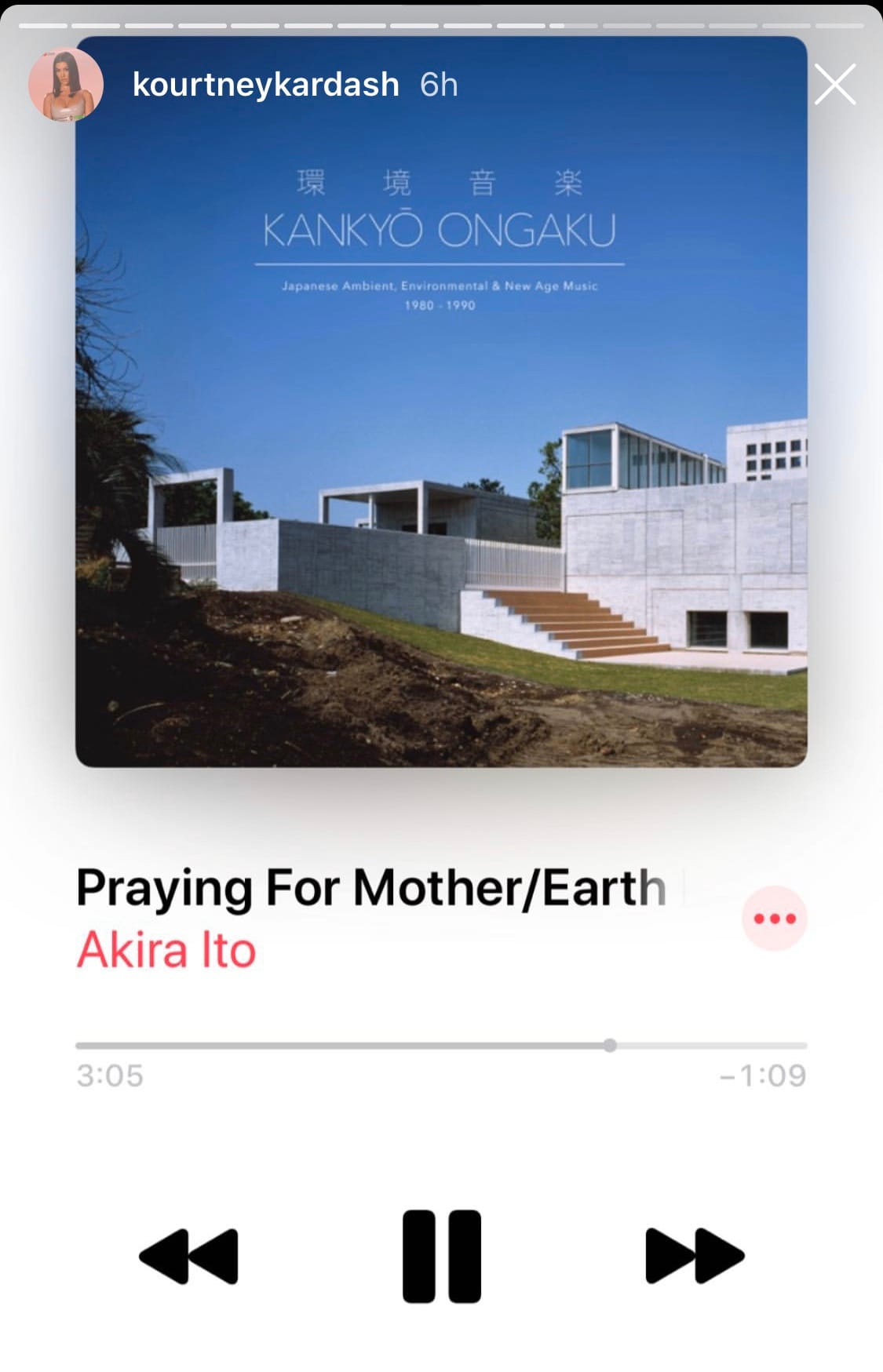
Should Be Asleep is the nom de plume of... well, I actually don't know. All I know is that they currently teach high school somewhere in Australia, that they have been uploading full length streams of left-field, mostly instrumental albums to YouTube for close to a decade–with a focus on Japanese environmental music, usually sourced from physical media they purchased in dollar bins or from online marketplaces–and that they are often the first person to make these records available for public consumption. They operate in a kind of parallel with famed reissue labels like Light in the Attic who, in 2019, released the landmark Kankyō Ongaku compilation, responsible for introducing Hiroshi Yoshimura to the broader population and also for this:
But their interests are also decidedly global: in doing some prep for this piece I became quite taken with Swiss musician Roger Melt's Les Chants de l'Univers, uploaded in February of last year. There are plenty of YouTube channels archiving rare music, but the quality and breadth of Should Be Asleep's output kept me coming back over the years. So I was thrilled when agreed to speak with me–under the condition of anonymity–about the work that they do, the ongoing reissuing of environmental music classics, and crate-digging in Australia.
This interview has been lightly edited for brevity and clarity. I included a few links explaining some of the more Australian colloquialisms to my mostly American audience.
Could you talk me through your general journey becoming interested in music? When did you specifically start gravitating towards the types of music you usually upload?
A good chunk of it is down to Triple J. In the mid noughties my sister bought me a DVD of a show made by the comedian John Safran, and I later found out he hosted a Sunday evening talkback show on Triple J with a larrikin-type pastor Father Bob that ran until 11pm. I’d tune in and listen while I played RuneScape. After that show, this program called “The Soundlab” would come on. Initially I’d just switch off and go to sleep, but after sitting through a few intros I’d keep it on and stay up for an hour or two. The Soundlab was pretty much 3 hours of electronica, IDM, glitchy beats, and ambient stuff, including music from little-known Aussie producers. After a slow start I fell absolutely in love with the show and the music.
I found a mate at school who had a similar taste in music, and as soon as we turned 18 we started going to live shows at this dimly-lit venue, tucked into the CBD and walled off with shipping containers. They’d have artists on the Brainfeeder roster showing up semi-regularly, and producers of a similar ilk playing every other week. Flume played there a bunch before he started doing big numbers. I didn’t really pay much attention to my physical or digital music collections then, as I was getting my fix by going to live shows. That joint shut up shop in late 2013. One of the last gigs I remember there was Oneohtrix Point Never and Actress; a pretty good way to go out.
I was already feeling a bit lost, and then not long after Triple J announced they were wrapping up the Soundlab program. I didn’t really have anything to fill the void after that. So I started buying a lot more stuff from the Bandcamps of artists I’d discovered on the Soundlab, and spent evenings watching Boiler Room sets on YouTube. That’s where I found the producer Andrew Wilson (aka Andras Fox, and half of fantastic duo Wilson Tanner). It was completely different to everything else I’d watched, firstly because he walked on and played an all-vinyl set, and secondly because he opened with the Stroer Duo’s Nomad Song and Marvin Franklin’s Kona Winds, which were very far removed from the Warp/Brainfeeder type stuff I was used to. I adored that set (still do), and tried to track down the titles of as many songs in it that I could. One of them turned out to be Takashi Kokubo’s “A Dream Sails Out To Sea”, which led me to Spencer Doran’s famous ‘Fairlight, Mallets & Bamboo’ mixes, and right on to Yoshio Ojima, Hiroshi Yoshimura, et al.
When did you start Should Be Asleep?
Nearly 10 years ago now and, to be honest, it feels like its been longer. COVID in the middle of that decade really warped my sense of time.
What made you want to start a YouTube channel?
Originally the angle was “hey I like this music and I think more people should hear it,” and I was just uploading music I liked that wasn’t on YouTube. This quickly morphed into uploading albums that I couldn’t find in full anywhere online. I remember being absolutely mesmerised by Yoshio Ojima’s "Organic Steps", but being frustrated that it was the only song I could find anywhere from his album Hands・Some. So the channel became more of a “hey I like this music, and its pretty hard to find, and it’d be a real shame if only the ~100 people who have it on cd/tape/vinyl were the only ones to ever hear it.”
Where did the name come from?
I was a uni student, and I’d reward myself with some digital cratedigging (i.e. browsing Yahoo Auctions Japan) only once I’d finished all my study. This meant all my "digging" was done between the hours of 11PM – 3 AM. Not that much has changed: I've just replaced "study" with "work," so the channel name is still appropriate.
How do you decide when something should be uploaded?
I have three (and a half) criteria for an upload.
One: do I enjoy it?
Two: is it available online in some form (free or paid)?
Three: is it more than twenty years old?
0.5: Is the cover art cool?
If an album meets those criteria it can be uploaded. The last 0.5 is shallow, but I do like to gaze upon a nice piece of cover art as I listen.
From browsing your Instagram it seems like you have a much larger collection than what's on YouTube at the moment.
I have a pretty solid backlog of music I think is awesome and intend to share but, since I’ve been running the channel, I’ve spent a cumulative 4 years ‘separated’ from my collection. I’ve worked some very demanding jobs as well, so unfortunately the time has gotten away from me a little and I’m not sure I’ll ever clear the whole queue – maybe in retirement…
Do you attempt any rights clearance? Have you ever been asked to take anything down?
In the past I had tried emailing or messaging artists prior to uploading their work, but I never heard anything back. I’m not a reissue label, so I don’t really try to get any permissions. I’ve been contacted with a takedown request 3 times, and of course I took the upload down each time.
I don’t monetise any videos, nor do I have a Patreon or any other avenue for profiting from this endeavour. I don’t want it to be ‘for profit.’ I think that signals the intent of the channel and makes it clear that I’m coming from a place of appreciation.
Have artists ever contacted you directly to thank you or show support?
A handful have got in touch! Super stoked whenever it happens. I've had a few directly wade into the comments on a video. Yantra De Vilder on her album Oceania, and recently Justine Bradley on Soulscape both spring to mind. I was also super chuffed reading Toshimi Mikami’s blog Micabox when he wrote about being happy that his album Quimai (気舞) was reaching a wider audience. He listed out all of his favourite comments under the upload.
You mentioned to me over Instagram that you teach high school. Do you see any similarity between your day job and the channel?
I don’t really see many similarities, to be honest! Though I’ve only been teaching high school for a year. I did used to be a synthetic chemist and there are a couple of parallels to be drawn there. The professor I used to work for liked to say, “3 months at the bench will save you an afternoon in the library.” It's a pretty common saying that discourages wide-reading in favour of hands-on experiments.
But this kind of sent me in the opposite direction, so I used to spend a lot of time digging out a lot of old journal articles (physical and digital!) when planning a project and designing experiments. There’s a fair bit of overlap between tracking down some obscure article in a foreign journal from the 60’s–70’s and the digging I do for the channel.
Where would you place what you do on the continuum of archival work and practice? Do you have any underlying philosophies for how you go about things?
I’m definitely a "don’t let the perfect be the enemy of the good" type operator. My tape and vinyl setups aren't great but they get the job done. I did recently upgrade my tape deck to a Nakamichi BX-100. I do spend a bit of time post-processing tape and vinyl rips (3-8 hours depending on the quality of the media), but I’m pretty light-touch with things like noise reduction, and do most click-removal manually. I still want listeners to recognise the formats the albums were originally released on and feel like they’re listening to a cassette or record.
There are some folk in the "bootleg-archivist" community with equipment and workflows that are far superior to mine, and the quality of their rips are incredible. But even so, this version of digging, ripping, and sharing doesn’t stack up against proper archival work. The positive of this more grassroots approach to "archiving" is that it lets more people hear a "worse" version of the album, compared to say something done by a proper archivist, which might get stashed away in an institution’s library.
So then sometimes this can be a more impactful way of "preserving" the music, especially if one of my crummy rips and uploads inspires a proper reissue, or brings an album back into the consciousness of people 20 or 30 years down the track who never would have heard it otherwise.
When reissues happen do the labels ever reach out or communicate directly with you?
Yeah a few have reached out for varying reasons. After I uploaded Yantra de Vilder’s Oceania I was contacted by a label asking for all the source material to help get a reissue going. Apparently the tape version of the album I uploaded was extremely scarce and not even the artist had a copy – I would’ve sent them one, but I was living in a remote part of Australia at the time and was thousands of kilometers away from my collection, so the best I could do was send them some .wavs and scans. Unfortunately, that reissue got shelved because of licensing issues; the artist sold a number of tracks on the album to a third party, or something like that.
Otherwise I do occasionally just get a message from a label just saying “Hey, we’re reissuing this!” which is always amazing to hear.
The famed Kankyō Ongaku compilation came out in 2019, so a little after you started Should Be Asleep. What has it been like watching the resurgence of this part of music history happen concurrently with (or after, if that's how you view it) your obsession and contributions?
Spencer Doran is behind that comp, and I think its unlikely that I become as interested in kankyō ongaku as I am without his aforementioned "Fairlights, Mallets & Bamboo" mixes. Plus, I don’t really think the channel had picked up much steam until 2020 when the Kokubo uploads became “YouTube RecommendationCore” during COVID lockdowns.
In short, it’s been pretty cool. The resurgence on the back of the Kankyō Ongaku comp has means this "genre" or philosophy has piqued the interest of literally millions of people worldwide, and its been a lot of fun to be even a little part of that.
Does the renewed interest in Japanese ambient/environmental music/new age change how you approach your work? Like do you feel compelled to focus on other regions and subgenres now that so many people are digging around in 80s and 90s Japanese music?
Yep, the popularity has changed my approach a lot. The channel actually went dark from mid-2022 to mid-2024.
There’s always been a community of diggers sharing Japanese ambient and new age, but since that community had expanded so much with all the interest, I started to feel like “someone else will do it." Like, if I just waited a few weeks or months, there would be a rip of pretty much anything up on YouTube or the file-sharing networks, so I felt there wasn’t much point in my carrying on the channel.
I had also gotten the feeling that the goldmine had been “all mined out,” and anything worth having would now cost me an arm or a leg. Even the more obscure albums by big-name (and not-so-big-name) Japanese ambient artists are eye-wateringly expensive to buy now, and have been for a few years. I’ve done it a handful of times, but I don’t fancy making a habit of spending hundreds on a single record or tape that may or may not have some great music on it. This put me off digging for a while. Not completely, but it certainly cooled my interest.
Plus the popularity of albums like Wet Land and Kokubo’s Ion Series caused me to kind of ‘raise the bar’ for what I considered ‘shareable’ on the channel. It’s dumb, but I'd even write off albums I liked because I didn’t think they were hands-down absolute masterpieces. Mikami’s Quimai is probably the first example of this. I really liked it, but felt like it was "too repetitive" for some reason, and it ended up staying on my shelf unshared for a few years before I reached for it again.
This all swirled together, and I didn’t end up sharing anything on the channel for 2 years.
For the last few years, I’ve shifted and favoured trying to find more ‘completely unknown’ artists and albums. Stuff that hasn’t really been on many peoples' radar. I’ve come across a lot more sub-par music as a result of this shift, but have also fished some gems out of the rough, which is extremely satisfying.
I’ve also shifted to looking in my backyard a bit more. We’ve got a lot of unique cultural and environmental elements in Australia, and they can be really evident in some of the Aussie new age/ambient music that’s floating around. There’s a good group of people digging around in Aus who are interested in that stuff – the folk at Bedroom Suck Records (their Midday Moon compilation from 2018 is awesome), and Chris Bonato from Left Ear Records is a powerhouse, to name a couple – but I don’t think the interest has really moved beyond our shores. So I’ve been keen on sharing that with more people, plus if I’m looking for more Aussie music I end up doing a bit more "real-world" cratedigging, as opposed to online-marketplace-surfing.
Is there any music that you're very passionate about that doesn't cross over with what you upload?
I do have a real soft spot for 90s hip hop, stemming from my early days on Bandcamp listening to Knxwledge’s WrapTaypes. That introduced me to Camp Lo’s "Luchini" amongst other classics. Dedicated Youtube uploaders (such as OGDonNinja) took the reins and showed me other great artists: Big Squig, Da Grassroots, and Lord Digga to name a few.
Do you have thoughts about the state of the music industry, specifically the streaming economy?
I don’t really engage with streaming platforms outside of YouTube, and I don’t have any idea what it's like trying to make it as an artist in the current environment. As a fan, I think Bandcamp seems to be the best (or least bad) platform for artists, so I buy most of my modern music – physical media or mp3s/flacs – through Bandcamp, and source stuff from older releases elsewhere. I still love the good old-fashioned download it to your computer approach.
Would you say your work is supplementary to streaming? Or would you consider it in opposition?
I'm sharing music that is pointedly absent from the streaming world (and, from what I can tell, major P2P sharing networks), so I guess you could think of the channel a supplement to streaming. But I don’t look at it that way and it's certainly not why I started. I love physical media and discovering new music. I also really enjoy sharing music I like with people, something I don’t get to do all that much in the "real-world." And I get to scratch both of those itches with Should Be Asleep.
With generative-AI music increasingly in the news these days, do you feel any particular impact on your work? You deal with a lot of new age and environmental music, stuff that is often composed with knowledge that it will be in the background.
That's a bit hard to comment on, because I–maybe naively–feel as though I listen to music in ways that don’t really expose me to gen-AI music. Half of the time I’m listening to a physical copy of a CD/tape/record produced before the AI-era, so I don’t really feel an effect there. And the other half I’m listening to something from a trusted uploader or Bandcamp label, so I’m fairly confident I’ve created a nice little AI-free bubble for myself.
The small sample of AI ambient music I have come across is still this bland, sterile, sonic wallpaper type stuff. It's awful, and doesn’t feel too far removed from some of the cookie-cutter new age music that was mass-produced in the 90s and early noughties. That stuff can be pretty awful too, but at least it was honest. At the moment, I think gen-AI can’t fake the sound design at the heart of a lot of environmental/ambient music, and I really hope it never does reach that point.
Are there any uploads you are particularly proud of, or stories from your time working on the channel that you want to tell or highlight?
Most proud of the ones that have had a part, however small, in bringing albums to the attention of some reissue labels. A few have been given the proper reissue treatment: Yabuki’s Body is a Message of the Universe; Kokubo’s Volk Von Bauhaus, and now Oasis of the Wind II (風のオアシスII) and Mikami’s Quimai, for example.
There’s no great story behind how I came to find those albums, though I will say that I nearly didn’t share Oasis of the Wind. I originally ignored the Ion series because I listened to Kokubo’s Jamaica (ジャマイカ~波と光と大地) first while I was on my way to work one day, and all I could remember was the high-pitched squawking of the bird at the end of the last track "星月夜 (Starry Night)". So all the Ion series CDs, which I’d bought as a bundle, sat unlistened-to on my shelf for a fair while. I can’t remember after how long, but eventually I re-listened to Jamaica and opened the other CDs in the series and realised what I’d been missing out on.
This is a bit more tangential, but a couple of years ago me and my partner quit our jobs, I put my records into storage, and we sold everything else that wouldn’t fit into a car. We packed up and drove around Australia, living out of a swag and the back of the car for basically a year. I did a fair bit of digging in the op-shops (aka. Goodwill or thrift stores) in some of the weird and wonderful small towns of Australia. Country towns are good for that. In the cities, op-shops have been cleaned out, but out in the sticks they’ve probably had the same records or tapes on their shelves for 10 years. A few months into the trip, I walked into this dusty old shop in a quaint little riverside town of maybe a few hundred people in South Australia, and walked out with a copy of a rare Cathie O’Sullivan LP, a sought-after (and recently reissued on Isle of Jura records) disco-aerobics LP and a sweet private press Aussie folk 12”, all $1 each and all in excellent condition. Great day.
A few weeks down the track we made it to the centre of Australia, a town called Mparntwe (Alice Springs). Alice is an interesting town in a lot of ways, one of them being that it seems to, according to an acquaintance, "attract a lot of alternative-lifers," by which they presumably mean hippies. So I figured it would be a pretty fun place to have a dig, and I did find a few great records and tapes in the second hand and op-shops in town. But after a few days in town I found out they had a tip shop as well, so I went out there for a fossick.
On the shelves, amongst a pretty sizeable collection of CDs was this weird tape with no j-card, just titled "Rocks Sing By Moonlight". And instead of sides A and B, the tape sides are labelled "Dawn" and "Dusk". Of course I buy it. I was pretty sure it would be good, or at least interesting, but I didn’t bring a walkman on the road with me to find out. I thought I’d be able to wait the six months until I got home to listen to it, but after a week or so I caved and bought a walkman off Ebay and got it shipped to the Alice Springs post office just so I could listen to the tape.
I love it. Both sides have this wonderful, long-form piece of sparse fourth world music, and one side (the "Dawn" side I think) tapers off with a beautiful meditative passage for the last few minutes. It was produced by a little-known group of musicians in Perth in Western Australia in the early 90s. I’ve since managed to find out a bit more about the group, but from what I can tell this album seems pretty un-Googleable. I’d love to know if it originally came with album art and a j-card, but I’m not sure I’ll ever be able to find another copy. I’ll share it once I get around to processing the rip; it definitely deserves a wider audience than just me, and the lucky few out there with a copy.
Oh, and in the same tip shop I found CD copies of Peter Mumme’s Coranderrk (really awesome album, beautiful artwork), and Vicki Hansen’s Children of the Sun (also excellent, and one I put on the channel a few months back). Easily one of my favourite days digging.
What advice would you give someone looking to start their own platform for uploading rare music?
If its ‘rare’ and you like it, chances are someone else will enjoy it too, so go for gold. I will say, though, some albums are obscure for a reason. I’ve listened to, and unfortunately owned copies of, a lot of not-very-good music over the years. For me, the great discoveries make the time spent listening to the dross worth it.
Should Be Asleep was also kind enough to put together a brand new mix special for Tributary, comprised of CD-based compositions that have not yet been uploaded to their YouTube channel (or anywhere else for that matter), and it's quite stunning. You can listen below:
Recommendation Corner:
READ:
Daniel Kolitz "Paid Phones" - another dispatch from one of the greatest currently doing it
Ella Dorn "'Giallobrutalism,' or why everything looks like that" - I've only watched a handful of pop music videos in the past few years, but I've watched more giallo than any sane person should in that same time frame. Loved nodding my head throughout this going "yeah, that makes sense." What a delight to see someone posting screenshots from The Fifth Cord in an effort to explain our current cultural moment
WATCH:
Her Private Hell (dir. Nicholas Winding Refn 2026) - speaking of giallo, this is somehow giallo-Sirk? Two hours of the hottest people alive blasting cigs, beating each other up, and moping in crazy lighting, with maybe the best score of the year. Extremely my shit
Late August, Early September (dir. Olivier Assayas 1998) - fired this one up in, wouldn't you guess it, early September. Funny, sweet, sad, just generally lovely